
Fintech Innovation & Open Banking
Role
Senior UX Designer
Duration
8 months
Year
2024
Overview
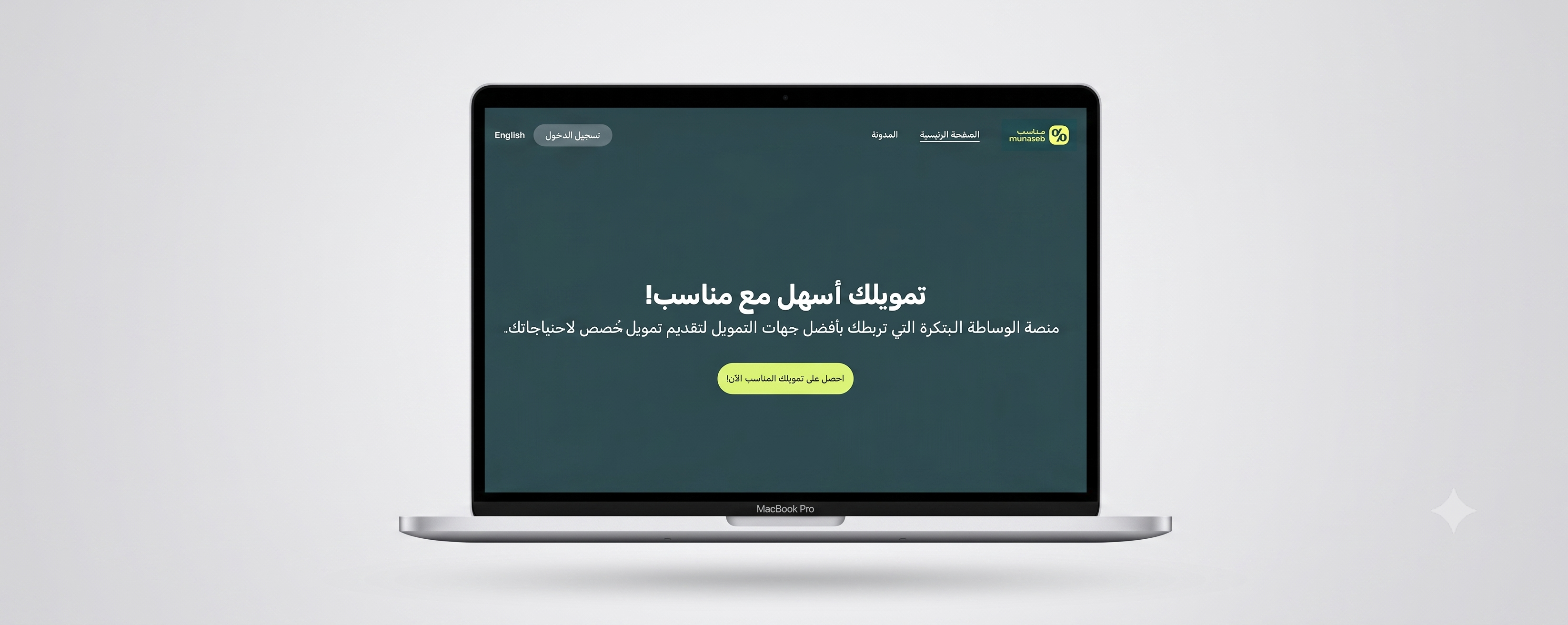
Munaaseb is a Saudi-based fintech platform that uses open banking APIs to deliver intelligent financial product matching — connecting users to the most suitable savings, investment, and credit products from across Saudi banks based on their real financial profile.
Project Details
The Problem
Saudi consumers face information overload when choosing financial products. With 30+ banks offering hundreds of products, the average user spends 4+ hours researching before making a financial decision — and still frequently ends up with a product that doesn't match their needs.
The Goal
Design a financial discovery experience that feels as effortless as Google Search — where any Saudi user can find, compare, and apply for the right financial product in under 10 minutes, using their real banking data to power personalized recommendations.
Research Insights
What the research revealed.
Trust Barrier
72% of surveyed users said they would not share banking data with a third party app unless they understood exactly what data was accessed and why.
Comparison Paralysis
Users comparing financial products across 3+ banks abandoned the task 68% of the time due to inconsistent product presentation and terminology.
Mobile-First Expectation
91% of target users in the 25-40 demographic expected a native mobile experience, citing banking apps as their primary financial interface.
Design Process
How it was built.
Wireframes
Mapped the full user journey from open banking consent through to product application. Wire-framed the consent flow with a transparency-first approach — every data permission explained in plain Arabic and English.
User Flows
Designed 3 primary flows: first-time setup with bank connection, personalized product discovery, and product comparison + application. Each flow was tested with 18 users across Riyadh and Jeddah.
Iterations
4 rounds of iteration focused primarily on the consent UX (reducing fear and increasing trust) and the recommendation card layout (making financial data scannable rather than overwhelming).
Final Solution
The delivered product.
A bilingual (Arabic/English) mobile-first fintech platform with a permission-transparent open banking consent flow, AI-powered product matching, and a side-by-side comparison tool that normalizes product terminology across all Saudi banks.
Transparent open banking consent flow with plain-language permission explanations
Personalized recommendation engine surface with match-score visualization
Bilingual RTL/LTR design system built entirely in Figma
Bank product comparison tool with normalized terminology
Design Decisions
Why these choices were made.
Consent-First Architecture
Making bank data permissions explicit and granular (not bundled) directly addressed the primary trust barrier — users who saw itemized permissions converted at 2.4× the rate of those shown a generic 'allow access' prompt.
Match Score over Rankings
Instead of ranking products by interest rate (a metric users don't fully understand), we display a personalized match score — shifting the frame from 'best in market' to 'best for you'.
RTL-Native Design
Rather than mirroring an LTR layout, we designed the Arabic version natively — which meant rethinking hierarchy, icon placement, and reading flow from scratch for an audience that reads right-to-left.
Outcomes
The results.
Consent Rate
+240%
Improvement vs generic permission prompts in A/B test
Task Completion
87%
Users completing product discovery in under 10 minutes
NPS Score
71
Net promoter score from beta users in Riyadh pilot
Drop-off
−52%
Reduction in comparison flow abandonment
Reflection & Next Steps
What I learned.
Munaaseb changed how I think about trust in digital products. Trust isn't a feeling — it's a series of design decisions that either accumulate or erode confidence. The single highest-impact change in the entire project was making permission explanations conversational rather than legal. In future fintech projects, I would build a dedicated 'trust audit' into the design process from week one.
Next Steps
Design a proactive financial health score feature with monthly insights
Expand to insurance product matching
Build a savings goal tracker tied to matched products