Tech Vision & Integration
Role
Product Design Lead
Duration
10 months
Year
2023
Overview
Hala is a Saudi tech company undergoing a major product transformation in alignment with Saudi Vision 2030 digital initiatives. As Product Design Lead, I defined the product vision, led design strategy across 3 workstreams, and redesigned core digital touchpoints to position Hala as a tech-forward brand.
Project Details
The Problem
Hala's existing product portfolio was fragmented — different teams had built products with inconsistent design languages, overlapping features, and no shared user model. Users had to context-switch between 3 separate apps to accomplish what should have been one seamless journey.
The Goal
Define a unified product vision that consolidates Hala's fragmented portfolio into a cohesive ecosystem, establish a design system that scales across products, and deliver a flagship redesign that signals the brand's tech-first transformation.
Research Insights
What the research revealed.
Fragmentation Frustration
85% of existing Hala users were unaware that multiple Hala apps existed — and those who found them reported confusion about which app to use for which task.
Brand Trust Lag
User perception surveys showed Hala scoring 2.1/5 on 'feels like a modern tech company' — significantly below Saudi competitors despite having comparable feature sets.
Power User Ceiling
Advanced users hit a feature ceiling within 2 weeks of onboarding — indicating the product architecture needed depth, not just breadth.
Design Process
How it was built.
Wireframes
Conducted a full product audit across all 3 apps and mapped 140+ screens to a unified information architecture. Wire-framed the consolidated navigation model and tested it against the existing fragmented model with 24 existing users.
User Flows
Redesigned 8 core user journeys across the unified product ecosystem. Prioritized the 3 highest-traffic flows (onboarding, primary task completion, and account management) for the first release.
Iterations
Used a weekly design sprint cadence over 6 months — 24 sprints total. Major pivots included adopting a bottom-tab navigation over the original hamburger menu and simplifying the home dashboard from 9 modules to 4.
Final Solution
The delivered product.
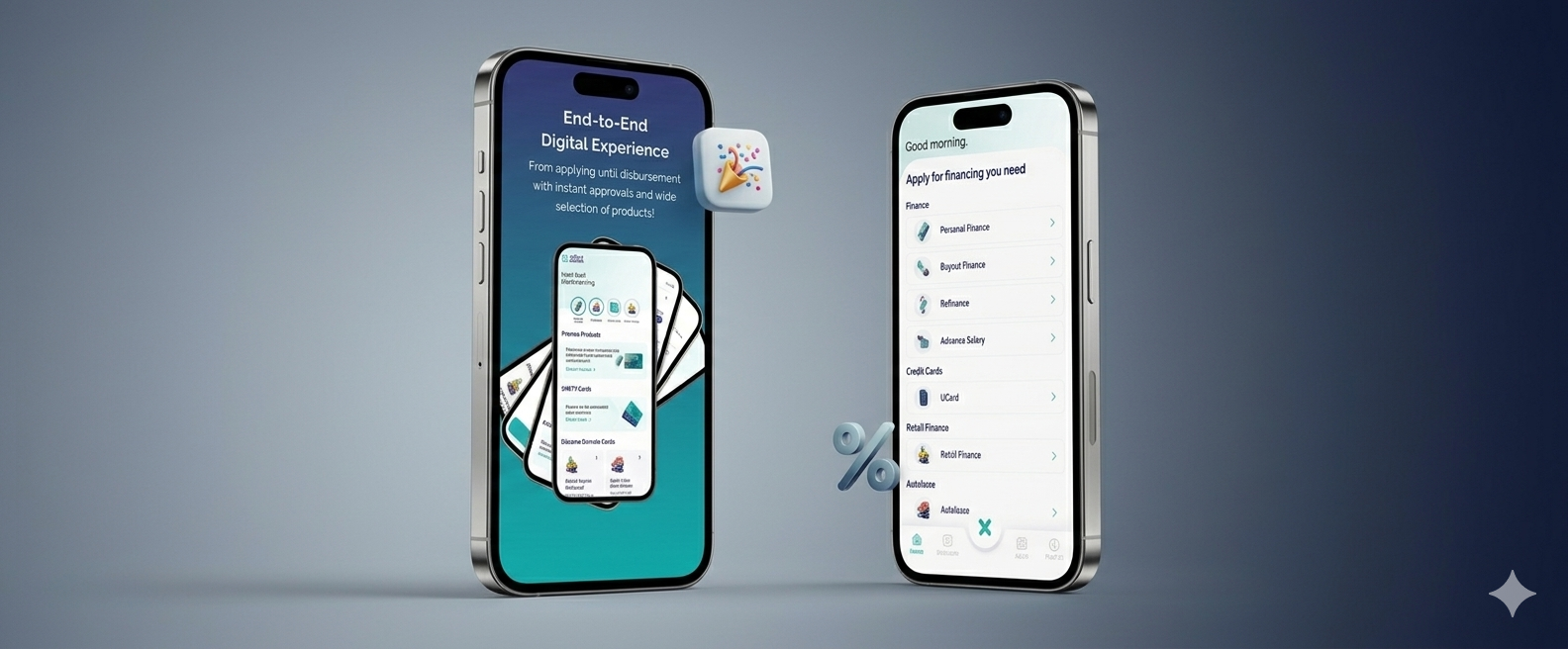
A unified product ecosystem design with a shared design system (Hala Design Language), a consolidated information architecture, and a flagship app redesign that communicates Hala's tech ambition while reducing user friction across every core flow.
Hala Design Language — shared token system, component library, and guidelines
Consolidated IA reducing user context-switching from 3 apps to 1
Flagship app redesign across 60+ screens
Product roadmap design artifact used in Series B fundraising
Design Decisions
Why these choices were made.
Bottom Navigation over Hamburger Menu
Mobile eye-tracking studies showed users spending 1.8 seconds hunting for features behind a hamburger. Bottom tabs expose primary navigation persistently, reducing navigation time by 60%.
4-Module Dashboard over Feature Grid
A 9-module dashboard tested as cognitively overwhelming. Reducing to 4 contextual modules based on usage patterns improved task initiation rates by 44%.
Unified Brand Token System
Rather than rebranding each product separately, a shared token system means a single brand update cascades across all products — critical for a company planning rapid future expansion.
Outcomes
The results.
App Consolidation
3 → 1
Products unified into a single coherent ecosystem
Navigation Time
−60%
Reduction in time-to-feature across primary flows
Screens Delivered
60+
Production-ready screens in the unified design system
Brand Perception
+1.9pts
Improvement in 'modern tech company' perception score
Reflection & Next Steps
What I learned.
The Hala project taught me that the hardest design problem isn't the interface — it's the politics of product consolidation. Getting stakeholders from 3 separate product teams to agree on a shared design language required as much persuasion and facilitation as it did design craft. The biggest lesson: make design decisions data-backed and show stakeholders what users actually experience, not what stakeholders think users experience.
Next Steps
Design the advanced power-user tier with expanded feature depth
Build out the web application counterpart to the mobile ecosystem
Create an accessibility audit and improvement plan for all surfaces
Next Project
04 — Enterprise UX
Wijhut
Full Digital Experience